
He added that opposition parties were assured that their concerns regarding the impact of the West Asia situation on India and the safety of Indian citizens were addressed in detail.

The United States, which entered this war in expectation of a short, sharp win along the Venezuela model, is now preparing for deeper involvement in a conflict it does not fully control, without the allies it typically relies on, against an adversary that is not behaving as expected, in a global environment that is already absorbing economic shock. Prem Panicker continues his must read daily blog on the Gulf War.

The question is no longer whether the war will expand. It has. The next few days will tell us whether the war stabilises around Hormuz or whether the Strait itself becomes the trigger for a far larger rupture. What to watch for over the next 48 hours is simple: Any move by the US toward direct naval control of the Strait; any credible Iranian attempt to disrupt or mine shipping lanes and, critically, whether energy infrastructure in the Gulf continues to be targeted.If those lines are crossed in tandem, the war will no longer be containable within the region.

The core issues to be settled -- access to Hormuz, Israel's aggression in Lebanon, the question of Iran's nuclear programme, sanctions relief and compensation -- are thorny enough to require weeks of patient negotiation. The most likely outcome of the opening sessions is that both sides take the measure of each other, establish what is and is not negotiable, and return home without having broken anything. That would count as progress.

Both sides have now revealed a preference for escalation over strategic defeat, and each new provocation narrows the space for the next pause. The Touska seizure, Iran's refusal to negotiate under blockade, Israel's strikes on Iranian oil infrastructure -- all of these add up to an increasingly untenable situation. This makes the wild card -- Trump and his motormouth -- more consequential than ever, notes Prem Panicker in his must read blog on the Iran War.

By all available indications, the White House drafted a face-saving note and handed it, ready-made, to Islamabad. Pakistani Prime Minister Shehbaz Sharif was supposed to then post it in the guise of a plea urging Trump to extend the deadline by two weeks 'to allow diplomacy to run its course'. Trump would then graciously accept Pakistan's 'request' and declare a ceasefire. Sharif dutifully posted the message on X. Except that he, or whoever was handling the account, forgot to delete the tell-tale first line visible in the edit history: 'Draft - Pakistan's PM Message on X'. Prem Panicker's must read blog on the Iran War.

'In such a scenario, Iran could proclaim itself victor, rebuild, re-enforce its diminished regional proxies to further destabilise neighbouring nations and take control of the Persian Gulf and Strait of Hormuz.'

Will rising tensions between US-Israel and Iran threaten crude oil supply through the Strait of Hormuz, putting India's fuel prices, imports, and economic stability at risk?

Taking Kharg would give the US control over virtually all of Iran's oil exports and thus provide significant leverage, notes Prem Panicker in his must read daily blog on the Gulf War. It would also put American troops within range of Iran's remaining missiles, drones, and artillery on a piece of real estate that is just eight square miles in size, and just 15 miles from the Iranian mainland.
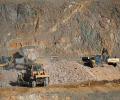
Western Coalfields Limited (WCL) has discovered significant concentrations of rare earth elements and critical minerals in its mines in Maharashtra, potentially transforming waste material into revenue-generating resources and diversifying the company's business.

Police in Tonk, Rajasthan, seized 150 kg of explosives, 200 cartridges, and fuse wire from a car, arresting two individuals. The explosives were concealed in sacks of urea fertilizer and were allegedly being transported for supply.
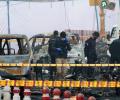
The Jammu and Kashmir Police have busted a 'white-collar' terror module, revealing that doctors arrested in the case had been radicalized since 2016 and formed a new terror organization named 'Ansar Interim' to carry out subversive activities.

Uttar Pradesh Chief Minister Yogi Adityanath asserted that Uttar Pradesh enjoys a clean environment, unlike Delhi, which he likened to a 'gas chamber' due to its pollution levels.

Following a Supreme Court setback, Donald Trump has announced an increase in global tariffs from 10% to 15%, impacting international trade relations and raising concerns about economic repercussions.

India and Russia are poised to sign multiple agreements to bolster cooperation in various sectors, including trade and healthcare, during Russian President Vladimir Putin's visit to New Delhi. Discussions will also address the Ukraine conflict and efforts to increase Indian exports to Russia.
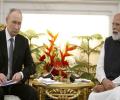
Prime Minister Narendra Modi strongly supported efforts to end the war in Ukraine and conveyed to Russian President Vladimir Putin that India will stand shoulder-to-shoulder in all peace efforts to find an amicable solution to the conflict.
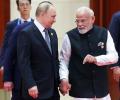
Prime Minister Narendra Modi will host Russian President Vladimir Putin for a private dinner and summit, focusing on defence, trade, and geopolitical issues, including the Ukraine conflict and the impact of US sanctions.

Russian President Vladimir Putin's visit to India this week aims to secure energy supplies, stabilise defence deliveries and ensure bilateral trade continues smoothly despite strong Western sanctions, GTRI said on Tuesday.

India and Russia have agreed to encourage joint manufacturing of military hardware and spare parts in India, aiming to improve maintenance of Russian-origin defence equipment and boost overall bilateral defence cooperation.

Ten days after the devastating car explosion near the Red Fort, in which 13 people lost their lives and several others were injured, investigators say the incident is part of a broader terror conspiracy involving a professional network of radicalised individuals based in Faridabad, Saharanpur and Kashmir.
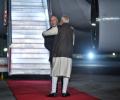
Russian President Vladimir Putin arrived in New Delhi for a two-day visit focused on strengthening ties with India, including defense cooperation and trade, amidst a changing geopolitical landscape.

The power sector presents a puzzle. A fast-growing economy should be aligned to higher power demand but that hasn't been the case in the financial year 2026 till date (FY26TD).

External Affairs Minister S Jaishankar discusses India's foreign policy challenges in a multipolar world, emphasizing the need for nimbleness and prioritizing national interests.

Putin's State visit will centre on fixing the huge India-Russia trade imbalance, with both sides pushing to lower duties, ease non-tariff barriers, and seal a landmark mobility pact to send more Indian workers to Russia.

'The government has put in a lot of effort to provide infrastructure for the industry.'
'The government has put in a lot of effort to provide infrastructure for the industry.'
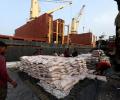
India's exports grew 6.74 per cent to $36.38 billion in September, while imports jumped 16.6 per cent, widening the trade deficit to $31.15 billion, the highest in over a year. The increase in inbound shipments of gold, fertiliser and silver has pushed the country's imports in September to $68.53 billion against $58.74 billion in the same month last year, official data released on Wednesday showed.

Maulvi Ishtiyaq told his interrogators a shockingly different story, claiming that Ganaie and Umar approached him earlier this year, asking him to store what they called "fertilisers" at his home and allegedly agreed upon a monthly storage fee of Rs 2,500, according to officials.
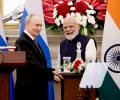
India and Russia have solidified a five-year plan to enhance their economic and trade partnership, while also addressing the ongoing conflict in Ukraine and the threat of terrorism.

Amid the political push and pull, the Centre's decision to allow sugar exports and remove the 50 per cent duty on molasses exports has rekindled hope in the industry that more relief may follow.

'They are a poor fit for anyone with near-term goals, low volatility tolerance, or a need for steady income or liquidity.' 'First-time investors should typically avoid them.'
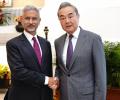
China promised to address three key concerns of India, the sources said.

New Delhi 'will have to take a call which supply source suits us the best,' the finance minister said, pointing out that crude oil accounts for the bulk of India's foreign exchange spend.

IMD data shows in the 24 hours between September 1 and 2, Haryana received 806 per cent more rainfall than normal, Punjab 759 per cent, Himachal Pradesh 510 per cent, Delhi 740 per cent, Chandigarh a staggering 1,638 per cent, and Rajasthan 193 per cent.

State-owned Oil and Natural Gas Corporation (ONGC) has reported a 10 per cent decline in its June quarter net profit on lower oil prices and stagnant production from its aging fields. The company reported a net profit of Rs 8,024 crore in the first quarter of 2025-26 fiscal year, compared to Rs 8,938 crore earning in the same period last year, a company statement said.

India and Russia always stood "shoulder-to-shoulder" even in the most difficult situations, Prime Minister Narendra Modi told Russian President Vladimir Putin on Monday, against the backdrop of possibly the worst phase in New Delhi's ties with the US in over two decades.

In response to US criticism of India's oil imports from Russia, the Indian Army shared a 1971 news clip highlighting the US's role in arming Pakistan.

Reliance Industries has served a notice for suspension of gas supplies to four fertiliser plants in Uttar Pradesh from Thursday unless they enhance their financial guarantees to cover for state sales tax.

Brave statements such as we will continue to be the fastest growing large country are of no consolation, because the direction of trade also determines the flow of investment, points out M Govinda Rao.
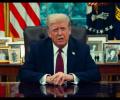
'What the US appears to be doing is to force India to be "the buyer of last resort", on whom their products can be dumped, 1.4 billion people have to eat something, so why not eat American corn?' 'What is exercising the Trump lot is the fact that most of the farms are in solidly Republican Midwestern states: Illinois, Indiana, Kansas, Michigan, Minnesota, Missouri, Nebraska, North Dakota, Ohio, South Dakota, Wisconsin,' points out Rajeev Srinivasan.
 © 2026 Rediff.com - Advertise with us - Disclaimer - Privacy Policy - Sitemap - Feedback - About us - Terms of use - Grievances